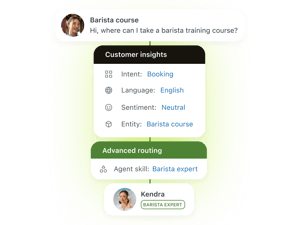
Still drowning in tickets? You don't need more agents, you need better structure
Whether your system is slowing you down or no longer scales, clear intake, smart self-service, and simple automation remove unnecessary volume so your team can focus on what truly matters.
Still drowning in tickets? You don't need more agents.
Whether your system is slowing you down or no longer scales, clear intake, smart self-service, and simple automation remove unnecessary volume so your team can focus on what truly matters.
High volume isn't always about popularity, it's often about poor structure. Repetitive questions, unclear forms, and missing automation create tickets that should never exist. Even with Zendesk in place, many teams miss the workflows that actually reduce demand.
Main reasons volume grows
Customers can't find answers easily
Help centre content is outdated, hard to navigate, or written in technical jargon customers don't understand.
Missing or unclear ticket forms
Forms lack structure or context fields, forcing agents to ask follow-up questions and creating unnecessary back-and-forth.
Manual triage slows everything down
Agents spend hours sorting and assigning tickets instead of solving them because routing rules are missing or broken.
Repetitive low-value question
Same questions arrive daily because self-service lacks answers or customers don't trust available documentation to be accurate.
What this means for support teams
High volume leads to backlogs, longer shifts, and inconsistent quality. The solution is not to work faster, but to create structure that prevents unnecessary tickets and speeds up internal processes.
Practical ways to reduce volume


Impact
At Premium Plus, we believe that guiding our customers to success is like helping them climb a mountain. Our solutions are designed to help you reach the top, where you can enjoy a 360-degree view of your company and everything you’ve achieved.
"We were overwhelmed with the same questions coming in every day. After Premium Plus restructured our Help Center and ticket forms, our volume dropped by 40% in just two months. Our agents finally have time to solve complex issues instead of answering 'how do I reset my password' for the hundredth time."
Common questions about high ticket volume
Adding agents treats the symptom, not the cause. If 60% of your tickets are repetitive questions that should be answered in your Help Center, hiring more people just means more people answering the same questions. You'll still have the same bottlenecks in triage, routing, and quality control. The solution is to reduce unnecessary volume through better self-service, clearer forms, and smarter automation. Once you've optimized your workflows, then you can assess if you actually need more capacity.
Start with ticket tag analysis in Zendesk Explore. Look for patterns: same subjects, similar descriptions, tags like 'password reset' or 'order status'. Pull reports on your top 20 ticket drivers by volume. If you see the same issues week after week, they're candidates for self-service or automation. A good rule of thumb: if agents answer the same question more than 10 times a week, it should be in your Help Center with a clear path for customers to find it.
This often reflects poor Help Center quality rather than actual customer preference. When content is hard to find, outdated, or written in technical language, customers give up and submit tickets. The key is creating articles that are genuinely helpful: short, visual, step-by-step, and easy to discover. Good self-service doesn't force customers away from agents, it gives them a faster option for simple questions while preserving agent time for complex issues that actually need human help.
Failed automation usually happens when teams try to automate too much, too fast, without proper rules or monitoring. Start small: one routing rule for one ticket type. Test it for two weeks. Monitor misroutes. Adjust. Then add another. Use Zendesk triggers and automations for simple, predictable scenarios like escalating urgent tickets or auto-assigning based on form fields. Avoid AI-based automation until your basic workflows are solid. Automation should reduce manual work, not create new cleanup tasks.
Growth absolutely drives volume, but structure determines whether that growth is linear or exponential. If your ticket volume grows faster than your customer base, that's a structure problem. A healthy support operation scales at roughly the same rate as customers. If you're growing 20% but tickets are up 50%, you have preventable volume. Even in rapid growth, investing in scalable workflows, templates, and self-service ensures you're not just throwing agents at an inefficient system.
Quick wins like better ticket forms and routing rules can show impact within 2-3 weeks. Help Center improvements take longer because you need time to write content, promote it, and measure deflection. Expect 6-8 weeks for meaningful self-service results. The key is measuring correctly: track article views, deflection rate, and ticket volume by category. Most teams see 20-30% volume reduction within the first quarter if they commit to structured content creation and workflow optimization.
Talk to our service consultant
Get expert guidance on reducing ticket volume, improving resolution speed, and creating smoother experiences.