Skip to content

Deliver consistent, high-volume customer service across every channel

Turn seasonal peaks and high contact volumes into smooth, omnichannel support experiences — powered by Zendesk and implemented by retail CX experts.

Saas & technology

Built to scale SaaS support without slowing teams down

Fast-growing SaaS and tech companies face rising support volumes, evolving products and increasing customer expectations.

Premium Plus helps SaaS organisations use Zendesk to scale support efficiently, strengthen control and deliver measurable impact early.

Stocksy_unlicensed_comp_6838624
Trusted by leading brands

Why SaaS teams care about time to impact

SaaS leaders don’t question whether Zendesk is capable. They focus on how quickly it improves resolution times, reduces support load and supports growth without adding headcount.

In fast-moving environments, impact comes from simplifying workflows first, not from building complex process layers.

How to get impact fast

Results retail teams typically achieve

+35%
Resolution times

By reducing handovers and manual processes.

+9 pts.
CSAT

Through faster, more predictable support experiences.

+25%
Productivity

More tickets handled without increasing headcount.

Why Zendesk is built for modern SaaS support

Built for scale, not headcount

Zendesk helps SaaS teams handle growing support volumes without continuously expanding teams. Through automation, clear ownership and scalable workflows, support operations keep pace with product growth while maintaining predictable performance and service quality.

Stocksy_unlicensed_comp_6190844

Designed for complex tech stacks

Zendesk integrates seamlessly with CRM, product analytics, engineering and identity tools. This allows support teams to work with full customer and product context, reducing handovers, improving resolution quality and aligning support with the wider customer lifecycle.

20201126_Kurt-Premium Plus_0273-bewerkt-1

Data that drives better decisions

Zendesk provides actionable insight into SLAs, backlog health, contact drivers and customer effort. When configured correctly, support data becomes a strategic input for product, success and leadership decisions, not just an operational reporting layer.

20201126_Kurt-Premium Plus_0158-bewerkt-1

Retail service maturity model

Retail organisations rarely start at the same maturity level. Understanding where you are today determines what will actually deliver impact.

  • Level 1 – Reactive service

    Support is fragmented across channels. Response times fluctuate heavily during peaks. Reporting is limited and teams are constantly firefighting.

    Typical focus: visibility, basic routing, stabilisation

  • Level 2 – Structured operations

    Zendesk is implemented, channels are connected and basic automation exists. Performance improves, but optimisation is still manual and inconsistent.

    Typical focus: workflow design, reporting, early automation

  • Level 3 – Optimised retail service

    High-volume use cases are automated, agents work with full context and performance is actively managed across brands and regions.

    Typical focus: deflection, efficiency, consistent CSAT

  • Level 4 – Predictable and scalable

    Service performance remains stable during peaks. Data is used to forecast volume and improve journeys proactively.

    Typical focus: peak-readiness, continuous optimisation, cost control

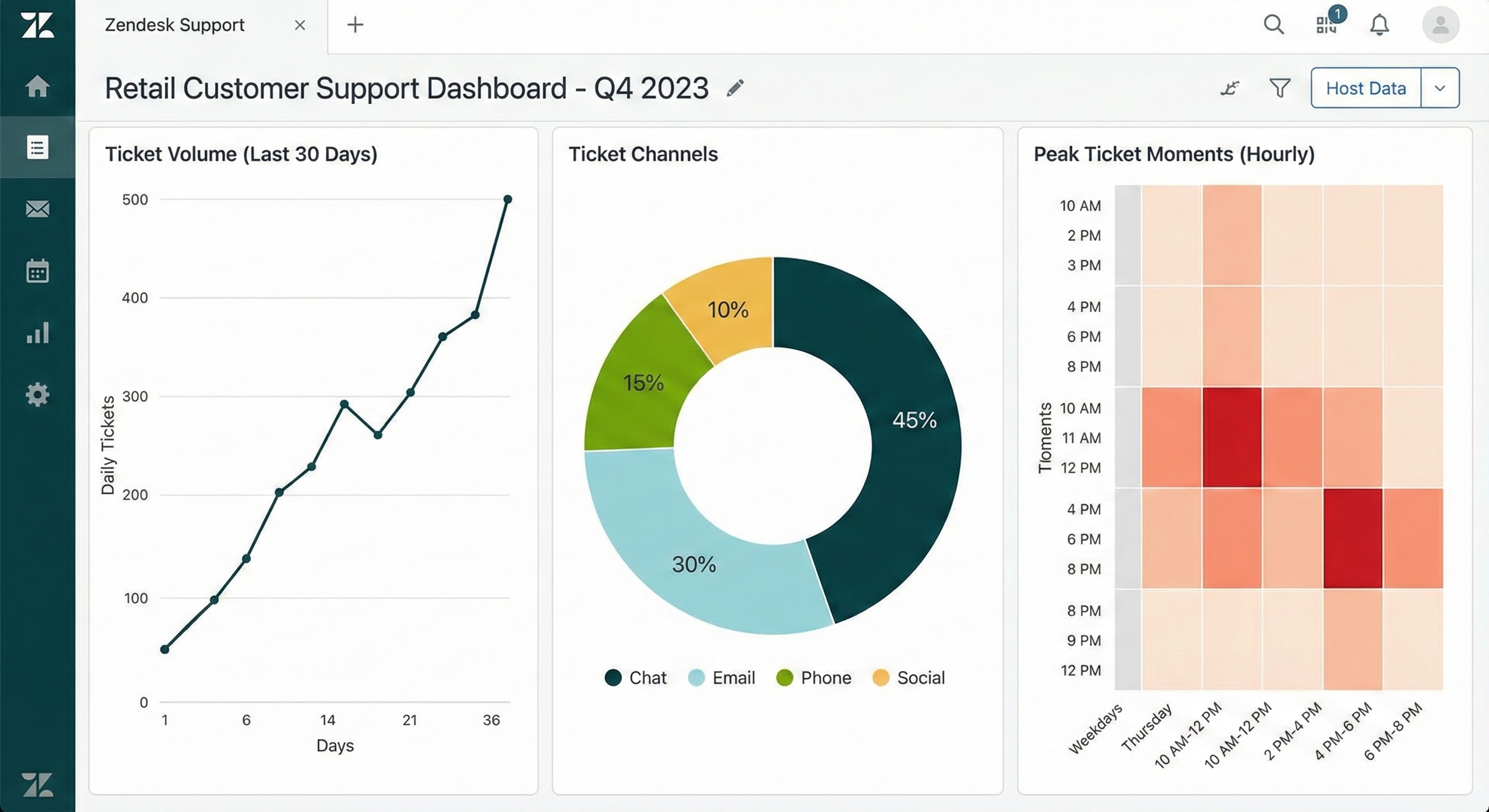
See how leading Software companies scale CX without scaling headcount

Get our CX Trends 2026 report to learn how top brands cut resolution time by 30% and improve loyalty through AI and automation.
Cover Zendesk CX Trends 2026

Results from teams just like yours

Campage-Shoot-12-07-23-126_2023-11-08-135622_spjd
hero-solution-1024x582
TUI_787_DREAMLINER_F048WebOriginalCompressed

SaaS service maturity model

  1. level 1

    Reactive

    Ad-hoc workflows, unclear ownership and growing backlog.

  2. Level 2

    Structured

    Zendesk implemented, basic automation and reporting in place.

  3. Level 3

    Optimised

    Automated workflows, clear SLAs and efficient global support.

  4. Level 4

    Predictable

    Support performance actively managed and aligned with growth.

How we help SaaS teams

Faster, smarter support for every shopper interaction

Frequently Asked Questions

How quickly can SaaS teams see measurable impact?

Most SaaS teams see improvements in resolution time, backlog and SLA compliance within the first weeks. Broader efficiency and CSAT improvements follow as automation, reporting and self-service mature over the first one to three months.

How does Zendesk scale as our SaaS business grows?

Zendesk scales technically and operationally, but only when workflows and ownership models are designed correctly. We ensure processes, permissions and reporting evolve alongside team size, product complexity and customer segmentation.

Can Zendesk support technical and tiered support models?

Yes. Zendesk supports tiered escalation, severity-based routing and engineering handovers. We design workflows that align with technical complexity, customer priority and incident impact rather than treating all tickets equally.

How do you integrate Zendesk with our SaaS tech stack?

We integrate Zendesk with CRM, product analytics, identity management and engineering tools. This allows support to become part of the broader customer lifecycle instead of operating as a standalone function.

How do you use AI without harming support quality?

We apply AI to assist agents, not replace them. This includes suggested replies, ticket summarisation and knowledge surfacing. Complex or high-impact cases always remain human-driven to protect customer relationships.

How do you measure support success beyond CSAT?

We track resolution time, backlog health, deflection, customer effort and support-driven churn signals. For SaaS organisations, support data often reveals product or onboarding issues before they appear elsewhere.

What usually slows SaaS support teams down?

The most common blockers are unclear ownership, excessive handovers, disconnected tooling and lack of actionable reporting. We address these first to unlock fast, sustainable improvements.

Frequently asked questions

Do you offer assistance for Zendesk implementation?

Most implementations take 4-8 weeks depending on complexity. We start with a discovery phase to map your workflows, then configure Zendesk to match your needs. Simple setups can go live in 2-3 weeks, while enterprise implementations with multiple brands and integrations typically take 6-12 weeks.

Can Zendesk integrate with our existing CRM and tools?
Yes. Zendesk offers native integrations with major platforms like Salesforce, HubSpot, Shopify, and Slack. We also build custom integrations using Zendesk's API to connect with your logistics systems, internal databases, or proprietary tools. Most integrations are completed within the implementation timeline.
What kind of ROI can we expect from implementing Zendesk? Our clients typically see ROI within 6-9 months. Key metrics include 25-40% reduction in cost per ticket, 30% faster response times, and 8-12 point CSAT improvements. The exact ROI depends on your current setup, but we provide a detailed assessment before starting so you know what to expect.
What support do you offer after go-live? We provide ongoing support through quarterly health checks, optimization sessions, and access to our team for questions or adjustments. We also offer training for new team members, help with scaling as you grow, and proactive recommendations based on Zendesk updates and industry trends.

Ready to stabilise and scale SaaS customer service

SaaS customer service does not need years to improve.
With the right focus, results follow fast.

Freddie Newsletter