Skip to content

Deliver consistent, high-volume customer service across every channel

Turn seasonal peaks and high contact volumes into smooth, omnichannel support experiences — powered by Zendesk and implemented by retail CX experts.

Retail & ecommerce

Built for scale, peaks and pressure in retail CX

Retail customer service teams work under constant pressure. Support volume spikes, seasonal peaks and rising expectations leave little room for experimentation.

Premium Plus helps retail and ecommerce organisations turn Zendesk into a stable, scalable solution that delivers measurable impact quickly, without sacrificing brand experience or control.

Stocksy_unlicensed_comp_6838624
Trusted by leading retail brands

Why retail teams care about time to impact

Retail leaders don’t question if Zendesk works.
They care about how fast it delivers results without disrupting daily operations.
In high-volume environments, impact comes from focus. Not from rebuilding everything at once.

What fast impact looks like in customer service

Results retail teams typically achieve

+30%
faster responses

By removing manual routing and repetitive questions.

+9 pts.
CSAT

Through consistent service across channels and regions.

+25%
Efficiency

Agents spend less time handling avoidable tickets.

Why Zendesk is a perfect fit for modern retail

Handle peak season surges

Scale seamlessly during Black Friday, holiday rushes and flash sales with intelligent routing, AI-powered triage and flexible agent scheduling that automatically adapts to spikes without compromising response times or service quality.

Stocksy_unlicensed_comp_6190844

Streamline returns and exchanges

Transform post-purchase friction into loyalty opportunities with automated return workflows, instant refund approvals and smart exchange suggestions that reduce manual processing time while maintaining full visibility across warehouses, stores and customer service teams.

20201126_Kurt-Premium Plus_0273-bewerkt-1

Bridge online and in-store

Unify digital and physical shopping experiences with real-time inventory sync, click-and-collect support and store staff access to complete customer profiles enabling seamless handoffs between web, app and physical locations for true omnichannel retail excellence.

Magasin-Jules-1-BF2-

Retail service maturity model

Retail organisations rarely start at the same maturity level. Understanding where you are today determines what will actually deliver impact.

  • Level 1 – Reactive service

    Support is fragmented across channels. Response times fluctuate heavily during peaks. Reporting is limited and teams are constantly firefighting.

    Typical focus: visibility, basic routing, stabilisation

  • Level 2 – Structured operations

    Zendesk is implemented, channels are connected and basic automation exists. Performance improves, but optimisation is still manual and inconsistent.

    Typical focus: workflow design, reporting, early automation

  • Level 3 – Optimised retail service

    High-volume use cases are automated, agents work with full context and performance is actively managed across brands and regions.

    Typical focus: deflection, efficiency, consistent CSAT

  • Level 4 – Predictable and scalable

    Service performance remains stable during peaks. Data is used to forecast volume and improve journeys proactively.

    Typical focus: peak-readiness, continuous optimisation, cost control

See how leading retailers scale CX without scaling headcount

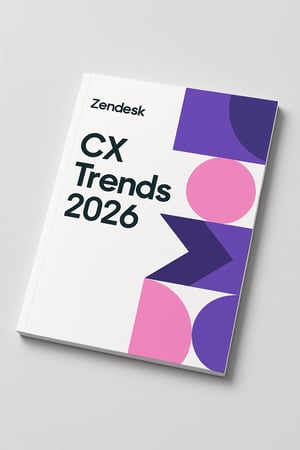
Get the CX Trends 2026 report to learn how top brands cut resolution time by 30% and improved loyalty through AI and automation.
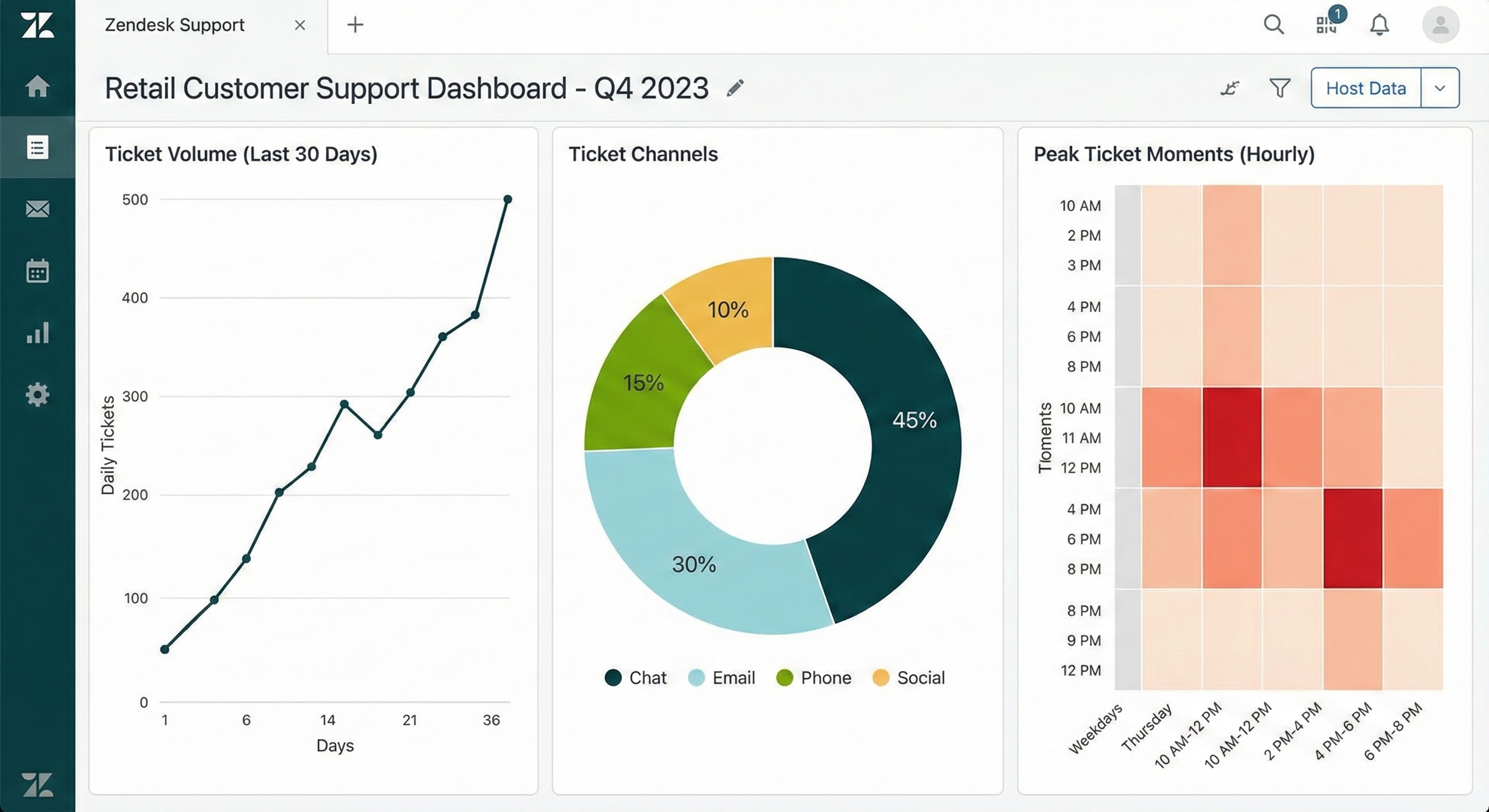
Cover Zendesk CX Trends 2026

Results from teams just like yours

Campage-Shoot-12-07-23-126_2023-11-08-135622_spjd
hero-solution-1024x582
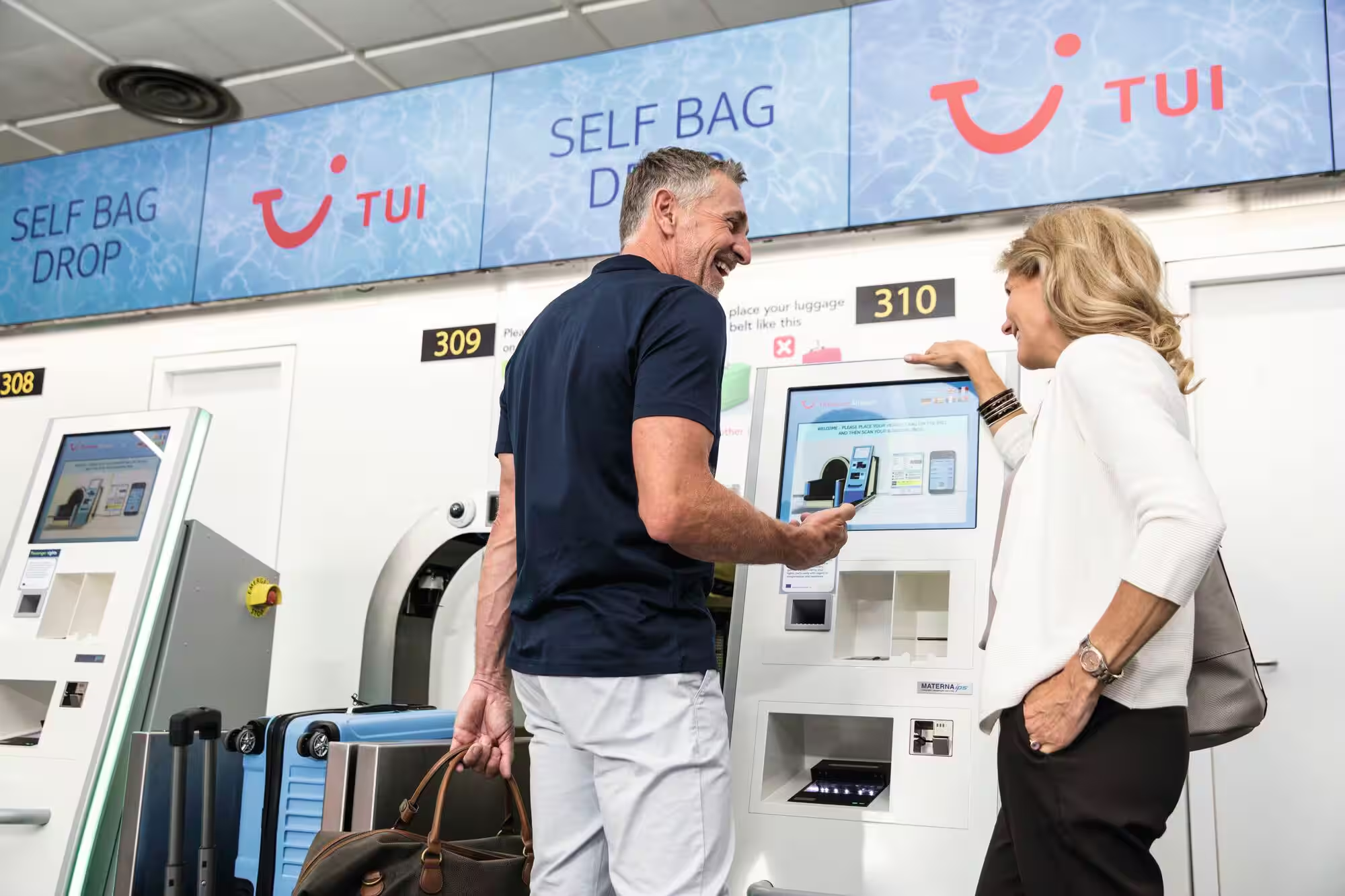
TUI_787_DREAMLINER_F048WebOriginalCompressed

Retail service maturity model

  1. level 1

    Reactive

    Fragmented channels, peak chaos, limited visibility.

  2. Level 2

    Structured

    Channels connected, basic automation, early reporting.

  3. Level 3

    Optimised

    High-volume cases automated, stable CSAT, efficient teams.

  4. Level 4

    Predictable

    Peak-ready, data-driven, cost-controlled service operations.

How we help retail teams succeed

Faster, smarter support for every shopper interaction

Frequently Asked Questions

How does Zendesk handle peak traffic without degrading service quality?


Zendesk uses asynchronous ticketing combined with real-time channels and intelligent routing. During peak periods, automation and AI deflect repetitive requests such as order status and returns, while priority routing ensures high-impact cases reach agents faster. We design peak-ready workflows specifically for retail calendars, not average volumes.

How do you prevent automation from harming the brand experience? Automation should support the brand, not replace it. We design tone-of-voice templates, escalation logic and human handover points so customers never feel trapped in automation. For retail brands, this balance is critical and requires careful configuration, not default bot settings.
Can Zendesk support multiple brands, regions and languages in one setup? Yes. Zendesk supports multi-brand environments with separate help centres, workflows and SLAs, while still providing central reporting. We design governance models that allow local flexibility without losing global control.
How do you integrate customer service with order and logistics data? We integrate Zendesk with ecommerce platforms, WMS and CRM systems so agents see order status, delivery context and customer history in one view. This reduces handle time and avoids channel switching. Where native integrations fall short, we build custom connectors.
What are common mistakes retail teams make with Zendesk? The most common mistakes are over-automation too early, copying workflows from other industries and ignoring reporting design. We correct this by starting with service journeys and KPIs, then mapping Zendesk to those goals.
How quickly can retail teams see measurable impact? Most retail clients see improvements in response times and deflection within weeks. CSAT improvements typically follow once agents and customers adapt to the new experience, usually within one quarter.

Frequently asked questions

Do you offer assistance for Zendesk implementation?

Most implementations take 4-8 weeks depending on complexity. We start with a discovery phase to map your workflows, then configure Zendesk to match your needs. Simple setups can go live in 2-3 weeks, while enterprise implementations with multiple brands and integrations typically take 6-12 weeks.

Can Zendesk integrate with our existing CRM and tools?
Yes. Zendesk offers native integrations with major platforms like Salesforce, HubSpot, Shopify, and Slack. We also build custom integrations using Zendesk's API to connect with your logistics systems, internal databases, or proprietary tools. Most integrations are completed within the implementation timeline.
What kind of ROI can we expect from implementing Zendesk? Our clients typically see ROI within 6-9 months. Key metrics include 25-40% reduction in cost per ticket, 30% faster response times, and 8-12 point CSAT improvements. The exact ROI depends on your current setup, but we provide a detailed assessment before starting so you know what to expect.
What support do you offer after go-live? We provide ongoing support through quarterly health checks, optimization sessions, and access to our team for questions or adjustments. We also offer training for new team members, help with scaling as you grow, and proactive recommendations based on Zendesk updates and industry trends.

Ready to stabilise and scale retail service

Retail customer  service does not need years to improve.
With the right focus, results follow fast.

Freddie Newsletter